On a county highway the truck is the county’s. On a village street it is the village’s. On a private road it is nobody’s, and in the kettle-moraine western half of the county that is a great many roads and the long drives that come off them.
Plowing on private roads and long drives is done by an independent operator under their own business name and insurance. This site arranges the introduction and nothing else.
Waukesha County plows the lettered county trunk highways, and under contract with WisDOT it plows the numbered state routes as well. Wis. Stat. § 84.07(1) lets the state contract with a county highway committee for state trunk maintenance, and WisDOT’s own winter FAQ says it “contracts with the 72 county highway departments to plow and provide ice control on all state and US-numbered highways and the Interstate system.” So on I-94, US-18, WIS-16, WIS-83, WIS-164 and WIS-190 in this county, the truck is a Waukesha County truck. On a city or village street it belongs to the municipality. The who-plows-your-street page works through the three cases.
On a private road there is no third truck. Nothing in the county’s Winter Road Management Program and nothing on any municipal page found for this site commits a public plow to a private road. Wis. Stat. § 86.105 lets a county, town, city or village contract to plow private roads and driveways if it chooses, and one village in the county does. The rest do not, and the arrangement on a private road is made by the road’s owners, which usually means by the association rather than by the house. The private-road association page covers that contract.
The Village of Chenequa is the one primary confirmation that Lake Country subdivision roads are private. Its zoning code, Chapter 6, § 6.17(4)(b)(ii), designates subdivision roads “private rather than public” and requires maintenance easements. The same chapter sets the lot: § 6.5(5)(a) requires a non-lake lot to have an average width of at least 200 feet and contain at least five acres, with lake lots at a 150-foot average width. No county-wide inventory of private roads exists, so the honest sentence is that many Lake Country subdivision roads are private, and the plat says whether yours is.
Chenequa also runs the § 86.105 program in practice. The village “offers snow plowing/salting services to all property owners but no property owner is required to use the Village’s services,” at the village’s published fee of $250 per driveway for the season; an earlier village agreement carried a lower figure, so confirm the current one with Village Hall before relying on it. The village uses “100% salt … applied only to the hills, turns and intersections,” and its rule is blunt: “Driveways must be marked or they will not be plowed.” There are no sidewalks in the village. A private operator quoting a Chenequa driveway is quoting against the village’s own truck, and the case for the private quote is the response time, the return pass and the salting policy, not the base price.
The county’s comprehensive plan reports that in 2005 municipal water served about 62 percent of the residential population, which leaves roughly 38 percent of county residents on private wells; the figure is two decades old and is the most recent one the county publishes. Public sewer covered about 19 percent of the county’s land area, and in 2000 the Lake Country sewer area counted 1,280 sewered residents against 11,110 unsewered, around Ashippun, Beaver, Keesus, North, Oconomowoc, Okauchee and Pine lakes and the Village of Merton. Every septic system in the county is in the Waukesha County Maintenance Program.
A plow operator needs to know where those two things are. A septic drainfield sits under lawn, often beside the driveway, and four feet of salted snow stacked on it all winter is a spring problem. A well head is a fixed object in the yard that a blade cannot see under a foot of snow. Neither shows up on a quote unless the owner points them out, and the staking rule that Chenequa and one Waukesha operator both insist on exists for exactly this. Stake the driveway edges, flag the well head, and tell the operator where the drainfield is before the first storm.
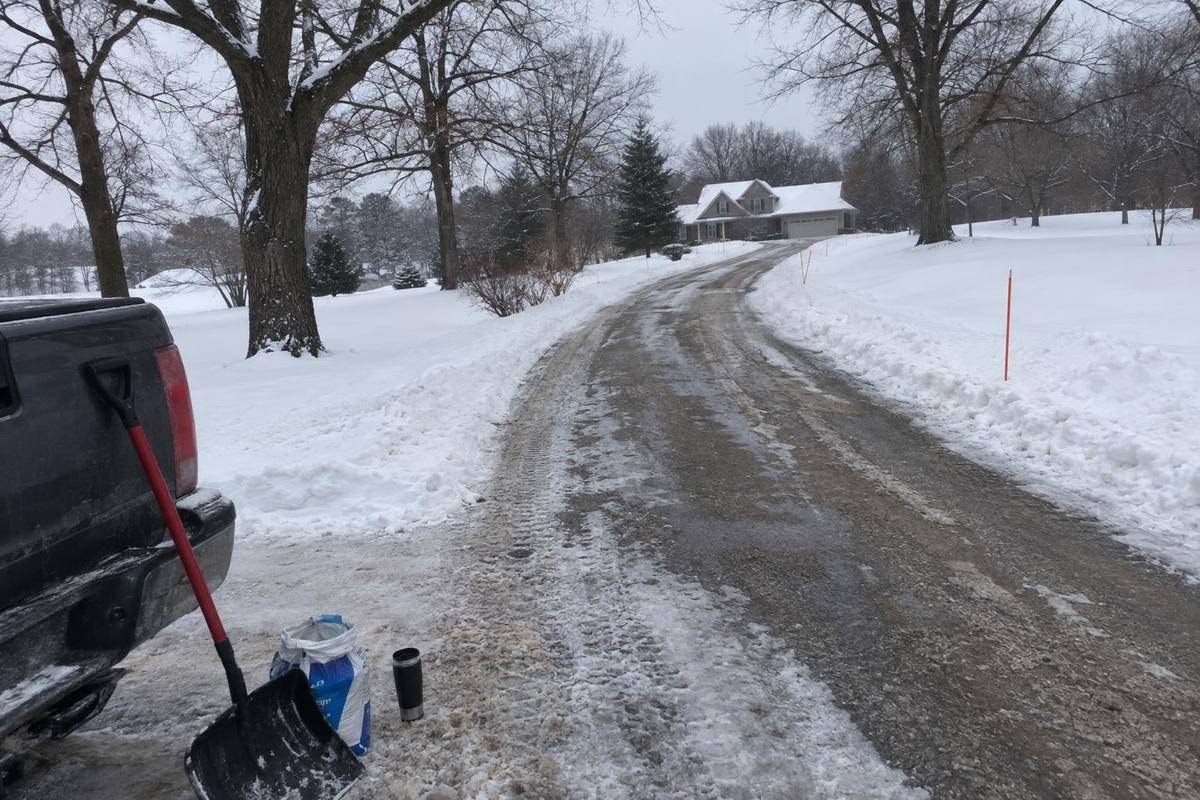
The county’s average residential lot is 0.67 acres, and Lake Country runs well above it; Chenequa’s five-acre minimum is the extreme. The DNR describes the terrain as the work of “massive lobes of ice (up to 2 miles thick)” that left “moraines, drumlins, kames and eskers,” and the county calls itself “lush rolling hills, abundant lakes.” A driveway across that ground is long, it may climb, and it may be tree-lined with nowhere to push at the sides. One Waukesha operator reserves the right to refuse a driveway that is “too steep”; that rule was written for this half of the county.
Length is priced by every operator whether or not they say so. A national marketplace app lists a $15 to $30 surcharge on any driveway over 50 feet, which is a national figure and not a local quote, but it shows the trade’s variable. Snow storage is the other: on a 200-foot drive the snow from the first three storms has to go somewhere the fourth storm’s snow can still be pushed past. An operator who has seen the drive in November can say whether a truck handles it or whether part of it is a blower job, and whether the turnaround at the house is big enough for the equipment.
A climbing drive needs ice control more than a flat one, and Lake Country is where the salt ends up in the water. SEWRPC’s Chloride Impact Study puts winter maintenance, public and private together, at approximately 59 percent of the region’s annual chloride load. Pewaukee Lake is rising roughly 2 to 3 milligrams per liter a year, and North Lake has gone from under 10 to over 40 since the early 1900s, on figures SEWRPC and Wisconsin Salt Wise presented to a Lake Country meeting in December 2025. Chenequa’s own answer is to salt only the hills, turns and intersections.
The county’s highway trucks switch from prewet rock salt to a hot load below 15 °F, because rock salt stops working around that temperature and the January normal low at Milwaukee is 17.2 °F. On a lake lot on a well, the product and the amount on the driveway matter twice: once for the lake and once for the well. The salting page has the temperature argument, and the lakes page has the water.
Give the driveway length, whether it climbs, where the well head and drainfield are, and whether the road it meets is public or private.
Call (262) 333-0458 Get a Seasonal Quote Waukesha County