The core seasonal product in this county. What the trigger means, why the lot size sets the price, when the truck comes, and where the snow is allowed to go once it is off the driveway.
Plowing is done by an independent operator under their own business name and insurance. This site makes the introduction and does not run a truck.
A driveway plowing contract in Waukesha County is three terms. The trigger is the depth at which the operator rolls, and the local operators who publish anything publish an inch: one Waukesha operator serves “every snow event with 1-2″ accumulation,” another says snowfalls over one inch trigger service. The count is what that trigger buys in a normal year, and the NOAA 1991–2020 normals for the Waukesha station answer it: 13.6 days a season reach an inch, 4.7 reach three inches. The visit standard is how the operator handles a long storm. One Waukesha operator’s published rule is that a 1–2 inch event is one visit at the end, and a 6–8 inch event is one visit during and one after.
Those 13.6 are days, not storms. A storm that starts one evening and ends the next afternoon counts as two days in the normals, so the number of separate events is somewhat lower. It is still the right number to carry into a quote, because it is what the operator is planning a route around. The seasonal-versus-per-visit page does the multiplication against the one published local per-event price.
The Waukesha County Housing Study of July 2023 puts the county’s 2018–2022 average lot at 0.67 acres, about 29,000 square feet, against 0.31 acres in Dane County. Brookfield wrote a 20,000-square-foot minimum lot for a single-family home into its zoning by 1985, and 69.3 percent of the county’s housing units are single-family detached. A plow operator does not price square footage; the operators who describe their pricing say it is set by “driveway size, sidewalks, property layout, service location and the type of coverage selected,” and driveway size on a lot this large means length.
Length shows up on the national marketplace apps as an explicit line: one lists a long-driveway surcharge of $15 to $30 on a driveway over 50 feet. That is a national “from” price and not a Waukesha County quote, but it shows the variable the trade prices on. A driveway that runs 150 feet back from the road costs more than a wide one at the street, and the western half of the county is full of them; the Lake Country page covers those.
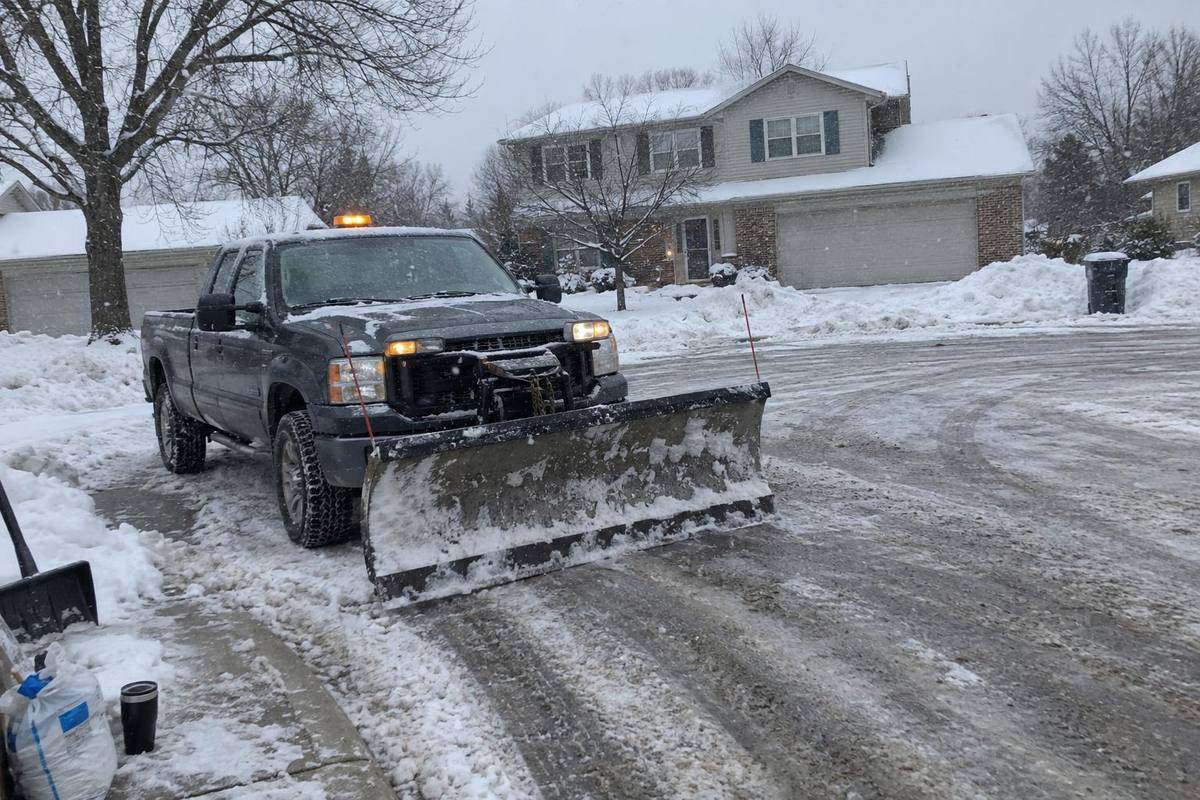
The published response standards in this county range widely, and none of them is the same as the sidewalk ordinance clock. One Waukesha operator serves “24 hours after the last snowflake falls,” stretching to 48 hours in an extreme storm. Another Waukesha operator publishes a 2–4 hour response window after snowfall ends. A Brookfield and Elm Grove operator says the response rate “should be anywhere between 4-8 hours.” The gap between the first standard and the second is a working day, and it decides whether the driveway is clear before the commute or after it.
For comparison, the county’s own Winter Road Management Program plans coverage of “up to 18 hours per day during the storm” on the county trunk highways, with route cycle times that “should generally not exceed 3 to 4 hours.” The village or city truck is on a separate cycle for local streets. A contract that names the hours is worth more than one that does not, and the number is worth asking for before the price.
Overnight parking matters to the same schedule. Every municipality in the county bans overnight street parking in winter, but the hours and the season differ in each one: 2–5 a.m. year-round in the City of Waukesha, 2–6 a.m. in Brookfield, 2–7 a.m. November through March in Merton, 2–8 a.m. November 1 through March 31 in Hartland. A car left in the street on a plow night is towed in Brookfield at the owner’s expense. The parking page has each municipality’s rule with its section number.
Wis. Stat. § 346.94(5) forbids placing on a highway “any foreign substance which is or may be injurious to any vehicle,” and Wisconsin municipalities apply it to snow plowed or blown into the road. Wis. Stat. § 86.022 makes willfully obstructing a public highway a misdemeanor. Every local code that addresses the subject bans it too. Delafield’s § 42-8(b)(2) is the sharpest: no snow “past the curb line or edge of the roadway pavement nearest their property,” and no mounds in the right-of-way that obstruct the view. Brookfield’s § 12.08.010 names the contractor along with the owner: “No person, their agent, employee or contractor shall deposit” material on any street, alley or pedestrian way without the city engineer’s permission.
New Berlin is the one municipality that says where the pile should go: “Snow from your driveway should be placed on the right side of your driveway as you face the street.” The reason is the berm, and the berm page explains it. On a corner lot, a cul-de-sac or a driveway with a retaining wall on one side, where the snow can be stacked is part of the quote. The Town of Oconomowoc’s snow policy says its own operators “will make every effort not to block driveways with snow in cul-de-sacs,” which is the closest any municipality in the county comes to acknowledging the problem.
One Waukesha operator reserves the right to refuse service “if driveway is not marked or if driveway is too steep,” and takes “Asphalt surfaces only.” The Village of Chenequa says the same about its own driveway program: “Driveways must be marked or they will not be plowed.” Stakes along the edges are not decoration on a driveway that runs across a lawn; they are what keeps a blade off the turf and off a septic drainfield in the dark.
Grade is a Lake Country question. The DNR describes the kettle-moraine terrain of the western county as “moraines, drumlins, kames and eskers,” and the county calls its own landscape “lush rolling hills.” Some drives climb. An operator who has seen the driveway before the first storm can say whether a truck handles it or whether it is a blower job. Surface is the same conversation: the asphalt-only rule exists because asphalt is common enough here to build a business rule around, and a paver or decorative concrete driveway needs a different answer before the season starts.
The clearest fact about this market is that residential capacity runs out early. One Waukesha operator posted “Currently FULL for the 2025-2026 Season!” before that season opened. A Brookfield operator advises early scheduling. Two Lake Country landscapers take commercial work only in winter. One 79-review operator’s site now reads “This business has been sold.” Of fourteen local operators read for this site, one publishes a residential dollar figure.
Three below-normal winters in a row at the airport, 32.6 inches, 30.3 inches and roughly 43 inches, make the routes feel roomier than they are. The normals say 13 or 14 plow days a year, and a contractor who priced last year’s route off a 30-inch winter has less room than the customer thinks. A request in September or October reaches an operator while there is still a slot on the route.
Have the driveway length, the surface, the grade and the trigger you want ready, and say whether the berm and the sidewalk should be in the same contract.
Call (262) 333-0458 Get a Seasonal Quote Waukesha County