The surface, the length, the grade and where the snow can go decide whether a truck blade or a blower does the job, and an operator who has seen the driveway in November already knows which.
Whichever equipment fits, it is run by the independent operator you are matched with, under their own name and insurance. This site does not own a blade or a blower.
The one local hint about what Waukesha County driveways are made of is a business rule. A City of Waukesha operator takes “Asphalt surfaces only,” which tells you asphalt is common enough here to build a service around, and that the operator would rather turn away the rest than run a blade over it. No local source gives the share of asphalt against concrete, and this site does not guess one. What it can say is what each surface asks of the equipment.
A truck blade on asphalt or broom-finished concrete is the fast, cheap, standard job, and it is what every per-push and seasonal structure in this county is priced around. Pavers are the clear exception. A steel blade edge catches a raised or settled paver and lifts it, and Milwaukee’s 53 freeze-thaw cycles a year are what settle and raise pavers in the first place. A blower clears a paver drive without dragging a steel edge across the joints. Decorative or stamped concrete sits in the same category. Gravel is the other exception: a blade set to the surface takes the gravel with the snow and leaves it on the lawn to be raked back in April, so a gravel drive is either plowed with the blade held up, leaving a packed base, or blown. A national aggregator lists gravel as a $50 to $100 surcharge, a national figure and not a local one, and the reason for it is the same either way.
A plow moves snow; it does not remove it. On a short suburban driveway between a garage and the street, with a house wall on one side and a neighbor’s lot line on the other, there is no place for a blade to leave a pile that will still be there for the fourth storm. The pile cannot go in the street under Wis. Stat. § 346.94(5) and every local code that addresses it, and in New Berlin it is supposed to go on the right side as you face the street, which on a short drive means the strip of lawn beside the apron and nothing more.
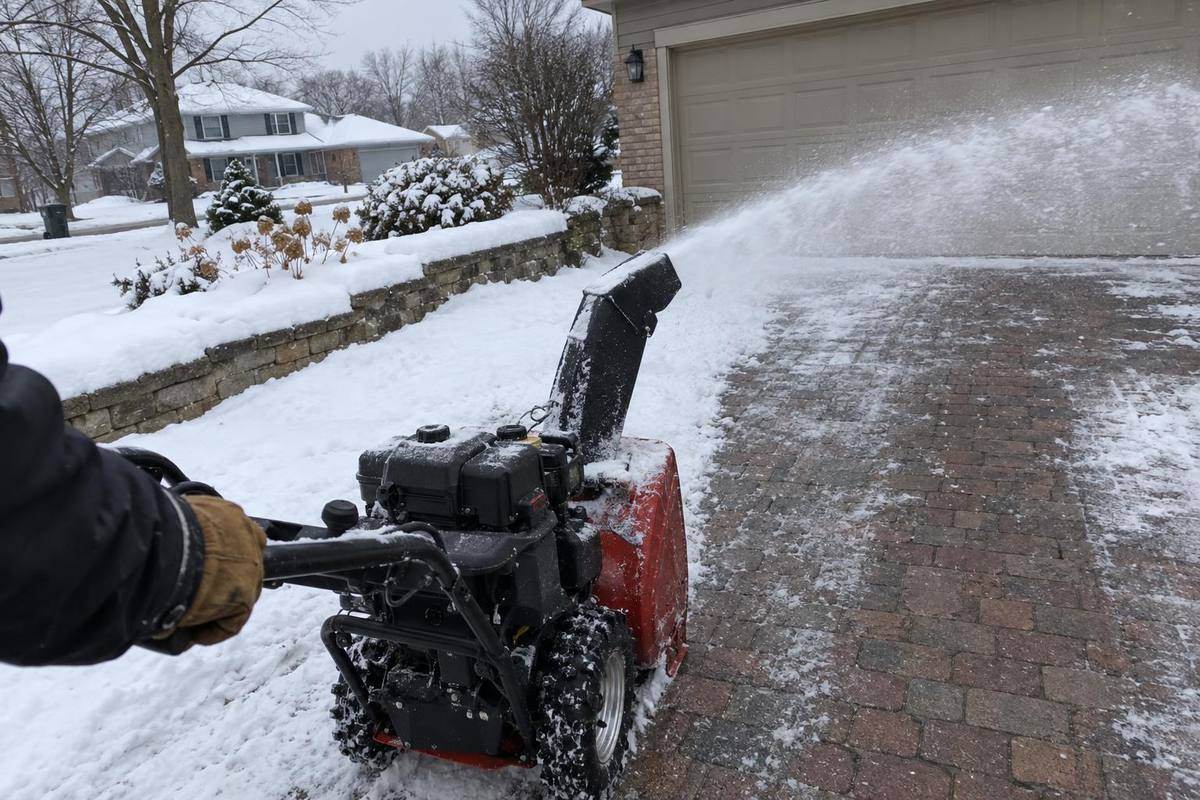
A blower throws the snow rather than pushing it, and it can put a season’s worth onto a lawn twenty feet away that a blade could never reach. The pile a blower leaves is also spread rather than stacked, which matters on a lot where a single tall pile beside the apron would block the view of the street. That is the case for a blower on any lot where the garage sits close to the street, and it is a stronger case on a corner lot with a sidewalk on two sides. It is also the answer for the berm the street plow leaves across the apron: a packed, salt-laden ridge is a blower job, and the berm page explains why it is the term to get in writing.
On a 200-foot Lake Country drive through the trees, the arithmetic reverses. A truck blade clears it in a few passes; a blower walks it. The county’s average lot is 0.67 acres and the western county runs above that, with Chenequa’s five-acre minimum at the top end, so the long drive is the county’s ordinary case and not its exception. The blade wins wherever there is length and somewhere along the edge to stack, which on a drive through a wooded lot is usually everywhere except the well head and the drainfield.
Grade complicates it. The DNR describes the kettle-moraine terrain as “moraines, drumlins, kames and eskers,” and one Waukesha operator reserves the right to refuse a driveway that is “too steep.” A climbing drive that a truck handles in December can be a truck it cannot get up in a January glaze, and the operator’s answer for the hill may be a blower, a tractor, or a different salting policy. The Lake Country page covers what else changes on that kind of lot.
Stake the edges either way. Chenequa will not plow an unmarked driveway and neither will at least one Waukesha operator, and a blower operator needs the edge as much as a blade does.
Asphalt, concrete, pavers or gravel; flat or climbing; where the snow can go. Those three answers decide the equipment before the price.
Call (262) 333-0458 Get a Seasonal Quote Waukesha County