Salt is an option on nearly every residential contract in this county, and on a share of January nights it does nothing. The county’s own highway department switches products at 15 °F. The lakes are the other half of the story.
Salting and de-icing are applied by the independent operator you are matched with, under their own name and insurance. This site arranges the introduction and spreads nothing.
The Wisconsin DNR’s own release says salt “is much less effective when pavement temperatures drop below 15 degrees.” WisDOT’s Tim Mason says that below 15 °F “salt becomes nearly ineffective.” And Waukesha County’s Highway Operations page draws the line for its own trucks: prewet rock salt “in temperatures above 15 degrees,” hot-load rock salt “between 15 and −5 degrees.” The county’s Winter Road Management Program adds that plowing “is to be the primary means of snow removal,” and that brine goes down ahead of a storm only when the pavement is at or above 23 °F, the wind is light, and no rain or freezing rain is forecast.
Now the thermometer. Milwaukee’s January normal low is 17.2 °F on the 1991–2020 normals, the winter average low for Milwaukee County is 18.1 °F, and the airport averages about 18 nights a year at or below zero. Those are lakefront numbers, and the lake moderates only about a mile to a mile and a half inland; Brookfield is fifteen miles from the water, and the county runs colder. No Waukesha-specific temperature normal was retrieved for this site, so the sentence is the county runs colder, not a number. On a meaningful share of January nights, rock salt on a Waukesha County driveway is below its working range. That is the whole case for a chloride blend or sand on a residential contract, and the county makes it with its own trucks.
The DNR’s driveway rule of thumb: “A 12-ounce coffee mug of salt is enough to treat an entire 20-foot driveway or 10 sidewalk squares.” The same release carries the line that “one teaspoon of salt is all it takes to make five gallons of water toxic for freshwater organisms.” Waukesha County calls itself “a proud member of the WI Salt Wise Partnership” and puts it this way: “More salt isn’t better or faster, it is just ‘more’.” Wisconsin Salt Wise reports municipal rates now around 200 pounds per lane mile, about 100 when pre-wetted with brine, down from a historical 500 to 800.
Two municipalities in the county say what that looks like in practice. The City of New Berlin “uses salt brine prior to snow events.” The Village of Mukwonago says anti-icing “decreases the application of annual salt application by 20% to 30%.” And the Village of Sussex does something no other municipality found does: it sells salt brine to residents at 21 cents a gallon, by appointment. A homeowner in Sussex can pre-treat a driveway the way the village pre-treats its streets. A contract that specifies the product and the rate, rather than “salting as needed,” is the one that can be held to the mug.
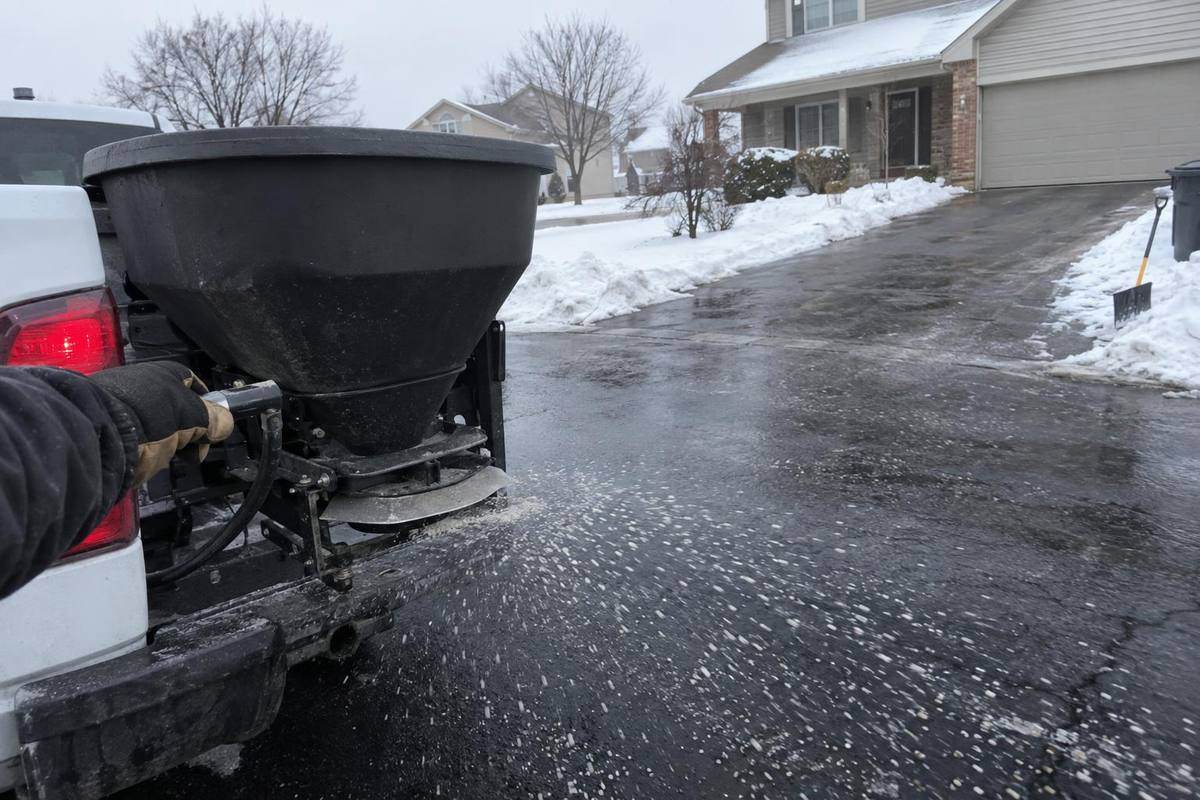
SEWRPC’s Chloride Impact Study, seven counties monitored from 2017 to 2021, finds winter maintenance, public and private de-icing together, to be “approximately 59 percent of the annual chloride load” in the region, the largest of eight sources, and reports that “nearly 90% of regional lakes with sufficient data show significantly increasing chloride concentrations over time.” The county’s own lakes are in the data. SEWRPC told the county on March 28, 2024 that Little Muskego Lake is “approaching 250 mg/l taste threshold.” At a Lake Country Clean Waters meeting reported by the Waukesha Freeman on December 13, 2025, SEWRPC and Wisconsin Salt Wise put Pewaukee Lake, Little Muskego Lake and Silver Lake at roughly 2 to 3 milligrams per liter of increase a year, North Lake at over 40 from under 10 in the early 1900s, and the Oconomowoc River below Lac La Belle at times approaching the state’s 395 mg/L chronic standard.
The Fox River at Waukesha has shown concentrations above the chronic toxicity standard “beginning in the early 2000s,” in the DNR’s Statewide Chloride Strategy. And the City of Waukesha is the one municipality in the county on an active chloride clock: its Clean Water Plant is under a WPDES chloride limit with a November 1, 2026 compliance deadline, measured 323 mg/L in effluent as of August 2026, and is paying residents to optimize or remove water softeners to reach it. The salt-and-the-lakes page carries all of this with sources. No ordinance in the county or the state restricts salt on private residential property; the pressure runs through municipal permits and voluntary programs, which is why what goes on the driveway is a contract term and not a rule.
Wisconsin Salt Wise is a coalition, not a state agency and not a credential. The certification that exists is the City of Madison’s Winter Salt Certification, run by Madison City Engineering, voluntary, and required by no city in the state of its contractors. An operator in this county who has taken Salt Wise training can say so, and it is a real fact about training. It is not a license, and it carries no legal standing.
It also carries no liability protection, and this is the point to be precise about. Wisconsin lawmakers have twice tried, in 2024 and 2026, to give trained salt applicators liability protection; neither bill became law. SB 52 passed both houses and was vetoed on March 29, 2024, with the governor writing “I object to creating such a broad immunity from liability.” SB 1019 failed to pass on March 23, 2026. The DNR’s own chloride workgroup had asked for the bill. So in Wisconsin today a trained or certified applicator has the same exposure as any other, and a homeowner’s exposure is unchanged by whom they hire. The liability page has the case law. This page will change when the law does.
The one published local salt price is a City of Waukesha operator’s $25 per 50 pounds applied when conditions warrant, on a per-event driveway service. National marketplace apps list salting “from $25” as a national floor. Nothing else local publishes a salt rate. What the clause should fix is not only the price but the product, because the product is what the temperature decides: rock salt above 15 °F, a calcium or magnesium chloride blend or sand below it, and brine ahead of a storm where the operator offers it.
Say whether the driveway climbs, whether it drains to a lake or a well, and whether the sidewalk is in a municipality that requires ice treatment.
Call (262) 333-0458 Get a Seasonal Quote Waukesha County