A driveway plowed at 5 a.m. and sealed at 9 by the county or village truck that finally reached the street. In Waukesha County nobody in government says whose ridge that is. The contract has to.
The return pass, where it is offered, is made by the independent operator you are matched with, under their own name and insurance. This site does not clear an apron.
Nothing, directly. The Waukesha County Winter Road Management Program tells its own operators to mind “curb and gutter ends, mailboxes, parked cars.” The Village of Pewaukee explains at length when it will and will not replace a mailbox. The Town of Brookfield says owners are responsible for snow removal in “driveways, mail boxes, fire hydrants and public sidewalks adjoining their homes.” The Town of Oconomowoc’s snow policy says its operators “will make every effort not to block driveways with snow in cul-de-sacs,” which is the only line in the county that admits the ridge exists. Not one county or municipal page found for this site tells a homeowner that the windrow across the apron is theirs to move.
It is theirs anyway. A street plow runs its blade continuously and every driveway it passes gets the ridge, and no municipality in the county offers to come back for aprons. The silence means the question lands on the private contract, and most residential contracts in this market do not answer it either. Fourteen local operators were read for this site; none publishes a berm return-pass price.
The berm is not the snow that fell. It is snow the street plow has pushed along the curb for a block, packed hard and full of road salt, and dropped in a ridge where the driveway meets the pavement. It arrives on the street plow’s schedule, not the contractor’s. On a county trunk highway or a numbered state route the truck is Waukesha County’s, running route cycles the county plans at three to four hours, up to 18 hours a day in a storm. On a village or city street the truck is the municipality’s on its own cycle. The who-plows-your-street page sorts out which truck it is. Either way, it commonly passes hours after the driveway was cleared.
Then the temperature does the rest. Milwaukee averages 53 freeze-thaw cycles a year, and the January normal low is 17.2 °F with about 18 sub-zero nights a season; the county runs colder than the lakefront. A berm that sat through a sunny afternoon and a 10 °F night is no longer snow. It is the ridge that a shovel bounces off and a small snowblower will not take, and it is what a contract without a berm clause leaves at the end of the driveway.
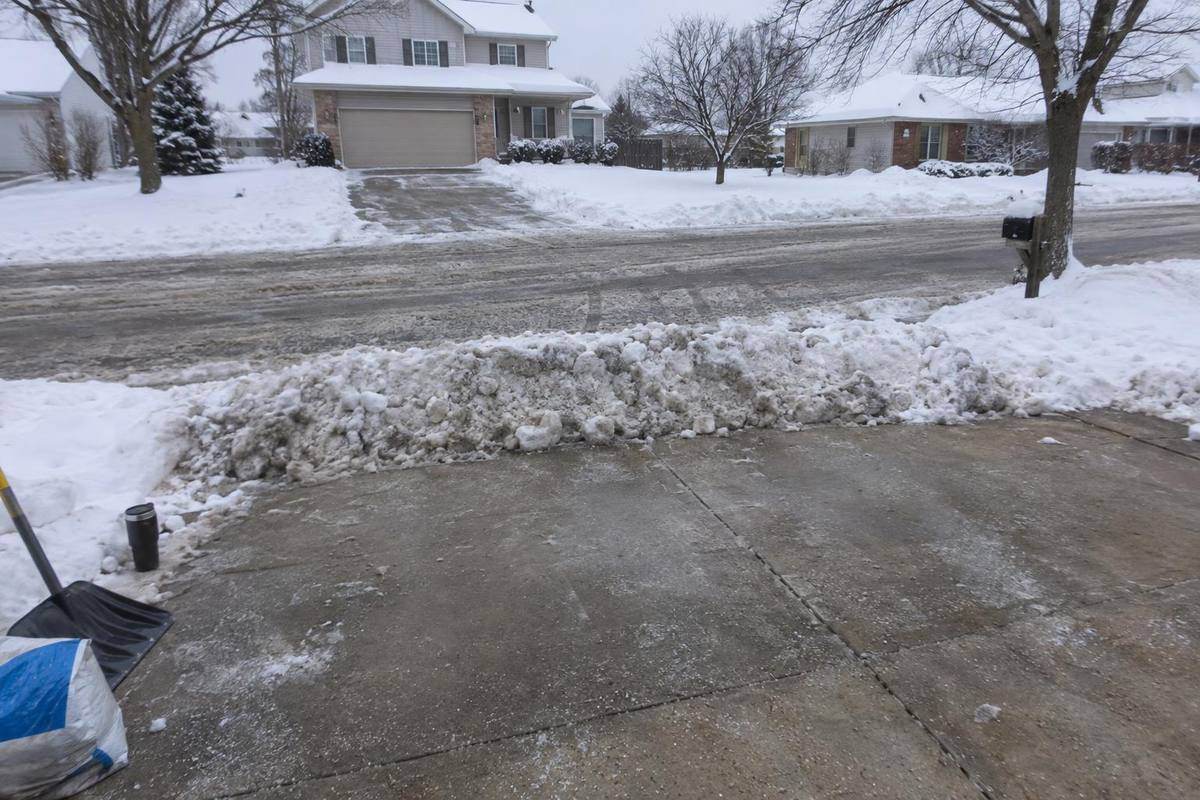
The operator comes back after the street plow has passed. It costs the most and it is the one structure that actually removes the ridge. Ask two things: whether it covers the apron by name rather than “the driveway,” and how the operator knows the street has been done. A Premium Seasonal tier marketed as “enhanced coverage during larger storms” may or may not mean this; make the operator say.
A fair structure if the number is on the page. Get the per-visit figure for the apron alone. Against the county’s 13.6 plowable days a year, a small per-berm charge can add more to the season than the gap between two quotes for the base service.
Most residential contracts in this market, because the question rarely gets asked. An operator whose route passes the house again may take the ridge without charge; nothing obliges them to. A contract silent on the berm has promised one clearing per event, on the operator’s timetable, and no more.
Ask the same question about a storm that stops mid-afternoon. The village truck may not reach the subdivision until after dark, and under a one-visit-per-event contract the afternoon visit is the visit.
The City of New Berlin is the one municipality in the county that tells residents where driveway snow should go: “Snow from your driveway should be placed on the right side of your driveway as you face the street.” A plow blade throws to the driver’s right, so a pile on the right of the apron sits where the blade has already passed, and a pile on the left sits where the blade is about to arrive and gets carried across the opening. The rule is on New Berlin’s hints page, and it works on every street in the county with a plow on it. It reduces the berm; it does not remove it.
The rest of the county writes the limit rather than the advice. Delafield’s § 42-8(b)(2) bars snow “past the curb line or edge of the roadway pavement nearest their property” and any mound in the right-of-way that causes a visual obstruction, with a permit exception from the DPW director that is the only snow-pile permit found in the county. Brookfield’s § 12.08.010 names “their agent, employee or contractor” alongside the owner. Sussex asks residents to clear “to the right side of the mailbox regularly (but avoid pushing snow into road).” The snow-in-the-street page has the statutes behind all of it.
The mailbox is the berm’s companion problem, and here the municipalities do speak. The Village of Pewaukee is liable only for direct contact by the plow, not for the load of snow it throws, wants a report within 24 hours with photographs, and replaces with “a standard #1 rural mailbox” or reimburses up to $35. Waukesha County says mailbox replacement “is done on a case-by-case basis and is not guaranteed,” will not replace one “deemed in already poor condition,” and installs a standard Post Office approved box and post where a county plow is at fault. Menomonee Falls says that “in most cases, a strong post and secure mailbox will withstand the impact of snow coming off of the snowplow.” Oconomowoc adds that mail may not be delivered unless the box can be reached.
The line those three draw is the same line the berm sits on: the thrown snow is nobody’s but the owner’s. A contract that includes a return pass for the apron should say whether it includes the mailbox approach, because the same truck buries both. Ask for it in the same sentence.
Say which street the driveway meets and whether it is a county highway, a village street or a private road, and ask for the apron by name in the quote.
Call (262) 333-0458 Get a Seasonal Quote Waukesha County