The sidewalk clock is set by the municipality, not the county, and it runs from 24 hours down to six daylight hours. Two cities do not put it on the owner at all. Here is who says what, and what it costs when the village does it for you.
Shoveling and blowing are carried out by an independent local operator under their own name and insurance. This site arranges the introduction and does not clear a walk.
There is no county sidewalk rule. Wis. Stat. § 66.0907(5) tells a city’s board of public works to keep sidewalks clear “in all cases where the owners or occupants of abutting lots fail to do so,” and each municipality writes its own deadline on top of that. A single sentence about the whole county would be wrong in at least two cities, so the table below is the page.
| Municipality | Deadline after the snow stops | Source and detail |
|---|---|---|
| Village of Elm Grove | 24 hours | § 243-13, “the entire width of the sidewalk” |
| Village of Menomonee Falls | 24 hours | § 90-67(a); salt or sand where ice “cannot be immediately removed” |
| Village of Pewaukee | 24 hours | § 78.118(a); unpaid charge a lien after 60 days |
| City of Delafield | 24 hours | § 42-8(a), full width, treated with salt, sand or ice melt |
| City of Oconomowoc | 24 hours | City page; includes adjacent handicap ramps |
| Village of Sussex | 24 hours | Village resident-information page |
| Village of Mukwonago | 24 hours | Village code-violations page |
| Village of Wales | 24 hours | Village code; removal at cost plus 15 percent |
| Village of Merton | Six daylight hours | § 198-5A; village clears “without notice” (§ 198-5B) |
| Town of Oconomowoc | “Promptly, each day” | § 260-25 |
| City of Waukesha | Not published here | The city’s own pages disagree; the codified section is Sec. 36-9. The bill rates are below. |
| City of Brookfield | No owner duty in the code | § 12.08.050 repealed by Ord. 2169-09 |
| City of Muskego | No owner duty | The city clears about 38 miles itself, after the roads, on a three-week cycle |
| Hartland, New Berlin, City of Pewaukee | Set by ordinance | Deadline not confirmed for this site; ask the municipality |
Chenequa has no sidewalks. The sidewalk ordinances page carries the section text for each of these.
Every municipality that puts the sidewalk on the owner also reserves the right to clear it and send the bill. The City of Waukesha publishes its rates: $2.00 per lineal foot, $25 per curb ramp, $25 per bus pad and $100 per fire hydrant, plus a $25 administrative fee for a second violation in a season and $50 for the third and later. Its list of violations includes “Snow placed in the street.” On a 60-foot frontage with one ramp, the first city visit is $145 before any administrative fee, which is more than most of a month of contracted service at the one published local rate.
The collection mechanism is the same across the county and it is a tax, not an invoice. Elm Grove’s § 243-16 charges the cost “against the abutting property each time” and, unpaid, makes it “a tax upon the premises.” Menomonee Falls puts it on the next tax roll as a special charge under Wis. Stat. § 66.0627. The Village of Pewaukee’s § 78.118(c) says the charge is “not payable in installments” and becomes a lien 60 days after the bill. Merton’s § 198-5B clears “without notice” and puts the charge on the assessment roll after ten days unpaid. Wales adds 15 percent administration to its cost. Delafield bills the owner directly and moves it to the tax roll after 30 days.
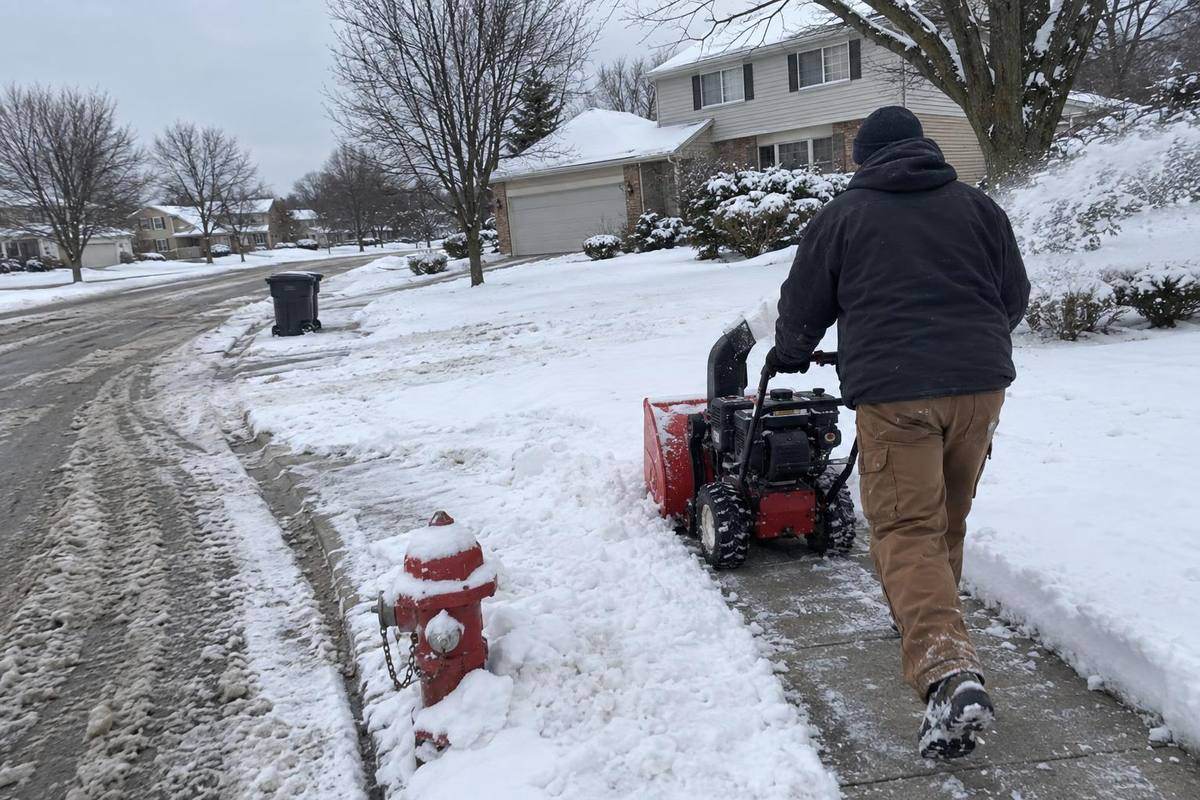
A corner lot has sidewalk on two sides, and every rule on this page applies to both. Elm Grove’s “entire width of the sidewalk” runs the full length of both frontages. Oconomowoc names “adjacent handicap ramps” as part of the owner’s job, and a corner is where the ramps are. The City of Waukesha’s bill rate is per lineal foot with $25 for each curb ramp on top, so the city’s own arithmetic prices a corner higher than a mid-block lot. An operator quoting a sidewalk add-on measures the same way; ask for the footage the quote covers rather than a flat “sidewalk included.”
Corners are also where the street plow leaves the most. Menomonee Falls tells residents that “a strong post and secure mailbox will withstand the impact of snow coming off of the snowplow,” and the same throw lands on the sidewalk at an intersection. A walk cleared at 6 a.m. and buried by the village truck at 9 is, under Wisconsin case law, a natural accumulation, and the clock is still the owner’s. That is the case for a contract that allows a second pass on a corner, not just one.
Shoveled sidewalk snow has one legal destination, and it is not the street. Wis. Stat. § 346.94(5) applies, and the local codes add their own lists. Elm Grove’s § 243-15 bars snow from private property being put “onto any fire hydrant, mailbox … paved right-of-way, public sidewalk, or other public place.” Menomonee Falls’ § 90-67(c): “No person in the course of removing snow or ice from any private property shall cause or permit such snow or ice to be placed or left on any public way.” The Village of Pewaukee’s § 78.118(e) and Merton’s § 198-5C say the same in their own words, and Wales’ § 419-8F forbids putting snow on a street once the street has been cleared.
Hydrants come up on the same pages. Menomonee Falls encourages residents to clear them. Sussex asks that mailbox posts sit at least five feet from a hydrant. The City of Waukesha charges $100 to dig one out. Ice is treated differently from snow in two codes: Menomonee Falls wants ice that “cannot be immediately removed” kept “sprinkled with salt or sand,” and Delafield wants the walk treated with “salt, sand or other appropriate ice melting products.” That makes ice control part of the sidewalk job in those two municipalities, and the salting page covers why the product matters at Waukesha County temperatures.
The gap that gets owners billed is between the operator’s response standard and the municipality’s clock. One Waukesha operator offers sidewalk shoveling free “as long as staff is available & can complete in 15 minutes,” on a driveway service that arrives “24 hours after the last snowflake falls.” Against a 24-hour ordinance that leaves no margin, and against Merton’s six daylight hours it does not work at all. A sidewalk in Merton needs an operator whose route reaches it the same morning, and the contract should say so.
Three things belong in the sidewalk clause. The footage covered, on both frontages if it is a corner. The width, since Elm Grove, Menomonee Falls and Delafield all require the full width of the walk. And whether ice treatment is included, because in Menomonee Falls and Delafield the ordinance asks for it. For a homeowner who cannot do the work and cannot buy it, Eras Senior Network matches volunteers to Waukesha and Milwaukee County seniors for the whole winter to shovel a driveway or sidewalk after it snows; no county-run program was confirmed for this site.
Name the municipality, the frontage in feet, whether it is a corner, and whether the walk needs ice treatment under the local code.
Call (262) 333-0458 Get a Seasonal Quote Waukesha County