A county of asphalt-shingle roofs over full basements, with 53 freeze-thaw cycles a year. The roof rarely fails. The water it sheds in the wrong place finds the window well, and the window well finds the basement.
Roof snow work is a separate trade from plowing and is done by an independent contractor under their own name and insurance. This site arranges the introduction and does not go on a roof.
The Wisconsin Uniform Dwelling Code requires “a 30 or 40 PSF snow load applied uniformly to roofs,” with the figure set by zone on the code’s map. Which zone Waukesha County falls in could not be read for this site, so the honest statement is 30 or 40 pounds per square foot depending on zone, and nothing more precise. Either way the number is a design load, and the county’s 39.5-inch normal season does not approach it in a typical year. The record depth on the ground at Milwaukee is 33 inches, from January 1979. In the storm of January 12–13, 2024, New Berlin measured 16.5 inches and Brookfield and Pewaukee 16.0. Those are the numbers a roof here has actually been asked to hold.
Structural roof failure is not the ordinary winter problem in this county. Water is. The roofs are asphalt shingle, the heat is forced-air gas, and what goes wrong is what happens to the snow between the ridge and the gutter over a winter of repeated thaws.
Milwaukee averages 53 freeze-thaw cycles a year on the State Climatology Office’s engineering weather data, and the January normal low is 17.2 °F with about 18 nights a year at or below zero. That is the climate an ice dam is made in: snow on the roof melts, runs down to a colder eave, refreezes there, and the ridge of ice that builds up holds the next melt behind it until the water backs up under the shingles. The cycle runs every time the temperature crosses 32 °F, and here it does that more than fifty times a season.
No University of Wisconsin Extension publication on ice dams surfaced for this site. The nearest authority is the University of Minnesota Extension, in the same climate and a different state, and its guidance is cited here with that caveat rather than presented as Wisconsin’s. Residents in this county do ask: a neighborhood forum thread titled “Looking for roof snow removal in Brookfield/Elm Grove” exists, which is the only evidence of the local market this site could find, and it contains no price.
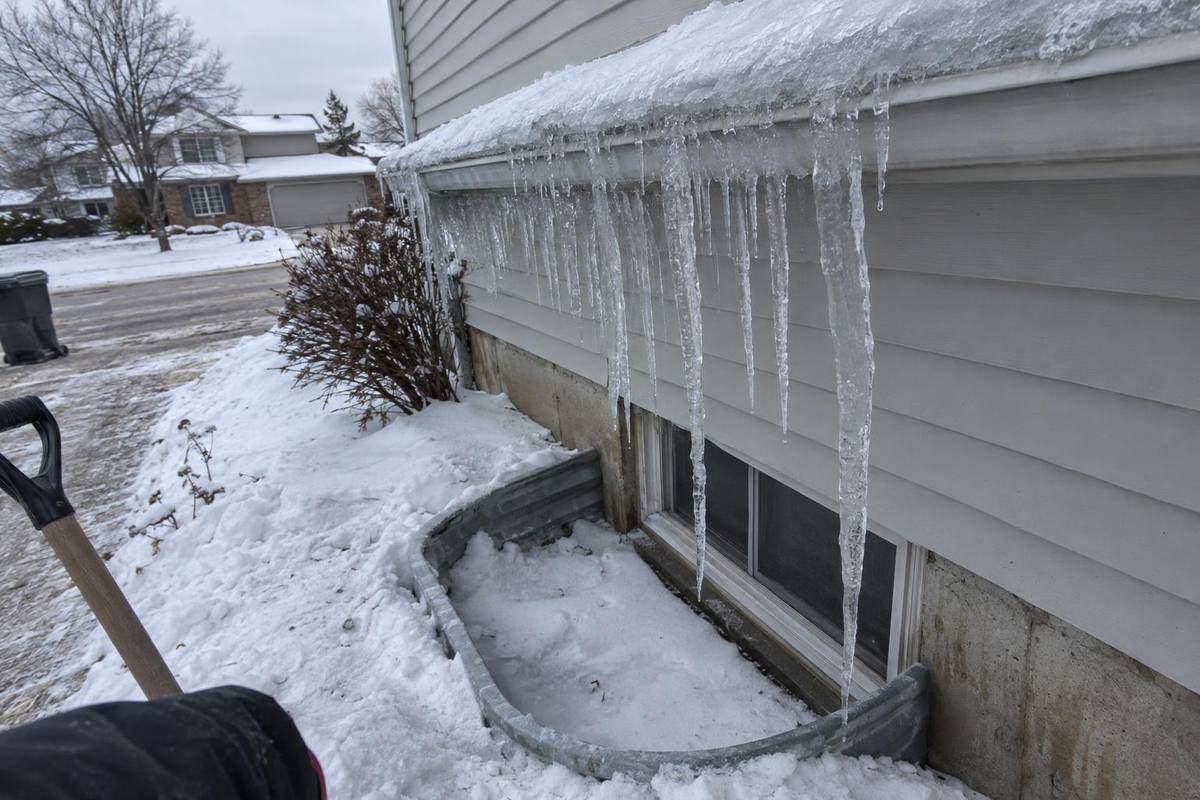
The Uniform Dwelling Code, SPS 321.16, generally requires a 48-inch footing depth to keep foundations below frost, and the 50-year ground frost depth at Milwaukee is 75 inches. With a hole that deep dug for every house, the full basement is universal in Waukesha County, and the basement is where roof water goes when an ice dam sends it down the wall instead of down the spout. Meltwater that reaches the ground beside the foundation and refreezes there; an egress window well that fills with sliding roof snow and then with the melt from it; a sump discharge line that freezes at the curb in January and backs the pump up. All of these are ice-dam problems one story down from the roof.
Two of them are on the ground and belong in an ordinary snow contract rather than a roof contract. A window well under an eave should be kept clear through the winter, and a sump discharge point should be kept open. Neither is a standard line on any local operator’s published service list, so both have to be asked for. The driveway page covers what a base contract includes; this is an add-on.
Roof snow removal is a separate trade from plowing. The independent contractors who do it take the snow load off the eaves so that meltwater has somewhere to go, and where a dam has already formed, open a path through it. It is not plow-truck work, and most of the operators who publish driveway service structures in this county do not list it. It is arranged separately, usually after the fact, and usually in February.
No local price for roof snow removal exists in anything read for this site, and none is published here. Fourteen Waukesha County operators publish driveway structure; none publishes a roof rate. The national aggregator sites that publish ranges for plowing do not publish a Waukesha figure for roofs either. What can be said is what to ask: whether the contractor carries general liability insurance that covers work on a roof, whether the method touches the shingles, and whether the quote is for the eaves only or the whole roof. Wisconsin does not license this trade any more than it licenses plowing, so the insurance question is the one that matters.
The airport measured 32.6 inches in 2023–24, 30.3 in 2024–25 and roughly 43 inches in 2025–26 on a figure derived from partial-season reports, all under the 48.7-inch normal. A homeowner who has not seen a roof problem in three winters has not seen a normal winter. The 33-inch record depth on the ground dates from January 25–27, 1979, and the November 28–30, 2025 storm set a daily record of 6.1 inches at Milwaukee on November 29 and put 12.7 inches on New Berlin, the largest two-day November snow since 1995. The load arrives early some years and all at once.
December through February carries roughly three-quarters of the season at every station in the county, and the coldest stretch at Milwaukee runs January 21–31. The dam forms across those weeks and the water shows up in the thaw after them. A February thaw is late to start looking for a contractor who works on roofs, and the best time to ask is when the snow contract is being arranged in the fall.
Say whether there is an existing dam or water inside, which eaves face the window wells, and whether you also want the wells and the sump discharge kept clear under the snow contract.
Call (262) 333-0458 Get a Seasonal Quote Waukesha County